AUSCPS is excited to host the 16th International Carnivorous Plant Society Conference in Darwin 2028.
Dates: The conference will be held over 3 days from Tuesday 2nd – Thursday 4th May 2028, with 3 additional days of field trips from Friday 5th – Sunday 7th May.
Venue: The conference will be held in the function centre of the George Brown Darwin Botanic Gardens, on Gardens Drive. The Botanic Gardens are located in the heart of Darwin and are close to the airport, casino and Mindil Beach.The function centre is located in the centre of the gardens and can cater for a maximum of 120 people in air conditioned comfort with access to clean and modern facilities.
Registration: Registrations for the conference will be open from the 1st of January 2027. The price of registration is AU$400 per person. However, we will be offering an early bird discount of AU$50 for those who register before the 31st of August 2027. Speakers will receive complimentary registration.
All registrations include morning tea, lunch (including water and fruit juices), and a special conference gift pack. In addition, all registrations will receive a free 12 month membership to the Australasian Carnivorous Plant Society where you will receive 2 electronic copies of Carniflora Australis, our bi-annual journal.
To express your interest in registering for the conference complete the registration form below.
Payment of the registration fee is via PayPal. Specific payment details will be announced on social media, email and the conference website closer to the registration date. Those who have registered interest on the website will be notified by email.
Field Trips: Darwin is home to over 50 species of carnivorous plants including petiolaris sundews, indica complex sundews, a huge diversity of bladderworts, Byblis and Aldrovanda. Many of the species are seasonal annuals with the best time to see them at the beginning of the dry season when the soil is still moist and the plants are mature and flowering.
The field trips will be held over Thursday the 5th to Sunday the 7th of May 2028. There are many sites that are easily visited and each host numerous species, making the field trip experience enjoyable, cost effective, safe and satisfying.
To protect the habitat where the carnivorous plants grow, it is proposed to utilise small groups (up to 12 people each including the guide) and visit separate sites to the other groups to minimise habitat damage via foot traffic. This option also makes group control easier to manage and therefore a better experience for the user.
The cost of the 3 days of field trips is dependant upon attendance numbers but is expected be about $150 per person. Deposits for the field trips will be taken at the time of the registration payment.
In the Northern Territory, collecting native plant materials from the wild is strictly regulated by the Biological Resources Act 2006 and will not be legally permissible during the field trips.
Conference Dinner: A Conference dinner will be planned at the end of the first day. The dinner will incorporate a 2.5hr cruise on Darwin Harbour and includes a buffet of local produce.
The cost of the cruise is dependent upon attendance numbers but is expected to range from AU$110 to AU$150 pp. This dinner will be optional with deposits taken at the time of the registration payment. Final payments for the cruise will be sent via PayPal invoice in early 2028.
Download the full information pack here
Please fill in the following Expression of Interest form if you would like to receive email updates about the conference.
Darwin 2028 Expression of Interest Form


Carnivorous Plants of Darwin
The Darwin region is home to an incredible 50 species of carnivorous plants across four genera – Drosera, Utricularia, Byblis and Aldrovanda. Early May, at the beginning of the dry season, is one of the best times to visit the region, as most sundews will have reached maturity and many bladderworts begin to flower as their wet-season habitats start to dry out. The plants are also remarkably accessible, with many species occurring in easily reached floodplains, soaks and seasonal swamps, often within an hour’s drive of Darwin’s CBD.
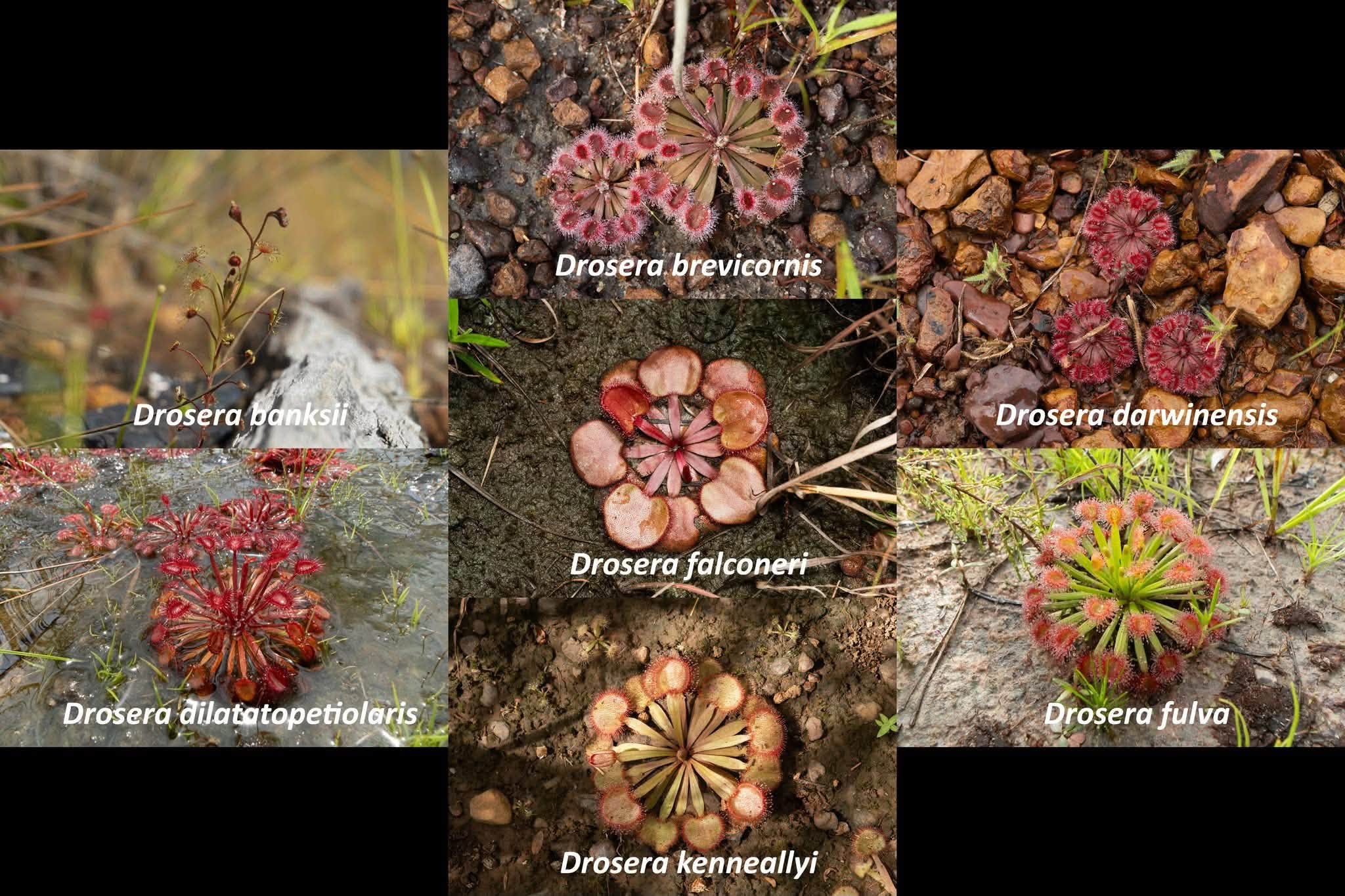
Twelve species of sundew occur in the Darwin region, including the famous Woolly sundews of section Lasiocephala, the Indica complex of section Arachnopus, and the widespread Drosera burmannii. The Woolly Sundews are particularly well adapted to the region’s pronounced wet-dry cycle. They grow actively throughout the wet season, taking advantage of the abundant moisture, before retreating to a dormant underground corm as the dry season progresses. By May, the plants will be beginning their transformation into dormancy, but most of the region’s seven Woolly sundew species should still be visible. At the same time, the four species of the Indica Complex and D. burmannii will be mature and flowering, making early May and especially rewarding time to see the diversity of Darwin’s Drosera.
Darwin is the world’s most biodiverse region for bladderworts, with 33 species recorded from the area. The diversity is reflected in their extraordinary flowers, which have a wide range of intricate morphologies. The region is home to the rare, antennae-bearing bladderworts, as well as tiny species such as Utricularia simmonsii and U. quinquedentata. Other common species, including U. holtzei, U. kamienskii, U. leptoplectra and U. chrysantha, are distinguishable by their intricately lobed flowers. The beginning of the dry season is an excellent time to search for these plants, as many species flower in response to their habitats becoming progressively drier.
Byblis aquatica is common in wetter habitats around Darwin, where its stems can float across the surface of shallow water, while B. liniflora occupies somewhat drier sites. The region is also home to the remarkable Waterwheel Plant, Aldrovanda, an aquatic carnivore that inhabits large lagoons. Taken together, these four genera make the Darwin region an exceptional destination for anyone interested in observing carnivorous plants in their natural habitats, with an extraordinary diversity of species packed into a relatively small and accessible area.